
How an Adjustable-Rate Mortgage Actually Works, and the Three Questions to Ask Before You Take One
October 16, 2026
The short version
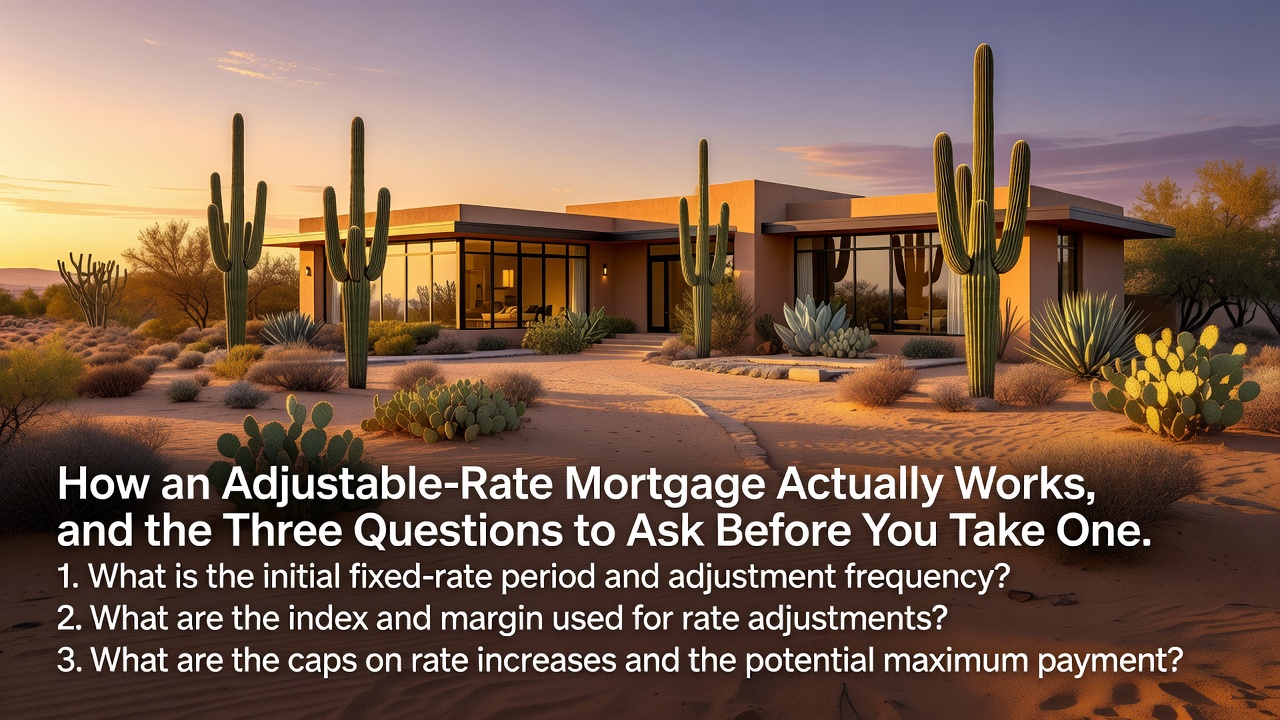
Adjustable-rate mortgages come up in conversation whenever buyers start comparing the starting payment on a fixed loan against the starting payment on an ARM and notice a gap. The gap is real. So are the rules that come with it, and the rules are what most buyers never read.
Here is the plain version. An ARM has two phases. In the first, the rate is fixed for a set number of years. In the second, the rate can adjust up or down on a schedule, usually once a year or every six months, based on a published index plus a margin the lender sets at the start. The loan documents spell out all of it: the index, the margin, the adjustment schedule, and the caps.
The caps are the part worth slowing down on. There are usually three. The first cap limits how far the rate can move at the first adjustment. The second limits how far it can move at each adjustment after that. The third limits how far it can move over the whole life of the loan. Together they define the worst case in writing, which is more than you get from guessing.
So the three questions to ask a lender are simple. One: how long is the fixed period, and does it line up with how long I expect to own this home? Two: what are the three caps, and what is my monthly payment at each of them? Three: what index and margin set the rate after the fixed period, and where can I look that index up myself?
What trips people up is comparing only the starting payment. A lower starting payment is the point of an ARM, and it can be the right trade when you expect to sell or refinance before the fixed period ends, or when your income has room to absorb a higher payment later. It is the wrong trade when the payment at the lifetime cap would break the budget and you have no plan for getting out before it matters. Nobody knows where rates land years from now, including me, which is exactly why the caps are the number to anchor on.
One more thing. Some ARMs carry a prepayment penalty, and some do not. Ask. If the whole plan depends on refinancing in a few years, a penalty changes the math.
This is general information, not legal or tax advice. Loan programs, caps, and index terms vary by lender and change over time, so confirm every specific with a licensed lender before you decide.
See what your home could sell for: https://www.previewarizonahomes.com/?utm_source=blog_pah&utm_medium=marketing&utm_campaign=daily
Jon Hegreness, REALTOR / Associate Broker, Howe Realty
(623) 826-0888 / JonHegreness@gmail.com / License BR540940000
9059 W Lake Pleasant Pkwy, B-200, Peoria, AZ 85382
previewarizonahomes.com

Jon Hegreness
REALTOR / Associate Broker · Howe Realty
AZ License BR540940000
Full-time Phoenix North Valley REALTOR and Associate Broker with 24 years in Arizona residential real estate. A negotiator and problem solver who works the way you would want a friend in the business to work: direct, on your side, and steady through the parts that get complicated.